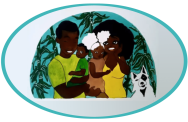
Children benefit from role models, their parents and caregivers.
According to the American Association of Children and Adolescent Psychiatry (AACAP) children look up to parents and caregivers to shape their behavior in school, relationships and when making difficult decisions.
Relatives, teachers, coaches, peers, celebrities such as athletes, entertainers, and characters from books, TV, movies or video games can also be role models to children.
Something to keep in mind according to AACAP. There is such a thing as bad and good role models for children. Children often mimic the behavior, beliefs and attitudes of their role models.
For examples, if the role model smokes, abuses alcohol or drugs, children often do as they have seen their role model do. Likewise, children raised in abusive homes are likely to abuse their spouses or become victims themselves of abuse, and or abuse their own children.
On the other hand, parents that exhibit healthy self-esteem will raise children who will make similar choices to bolster their confidence and hold themselves in higher regard. Children tend to choose the same profession or academic success as their parents or role models.
The reason children are often so much like their parents have to do with both nature and nurture.
While each of these states, nature and nurture come from the child’s parents, nature and nurture play a significant role in the developmental state of children, they will inherit and build on examples of their parents.
Nature has to do with genetics, thou heredity.
While, Nurture on the other hand has to do with the environment established in which the child is born.
Nurture is where parents have the most control over.
Parents have more control over the emotional environment and the kind of role model they exhibit in the home.
Because nature and nurture play significant roles in the developmental stages of children, the children will inherit and build on examples of their parents.
This latter process, nurture happens both consciously and without awareness on the part of the parent.
The Center For Parenting argues that children learn from observation and imitation, “As a parent, it is impossible to not model. Your children will see your example – positive or negative – as a pattern for the way life is to be lived…Depending on what you do or do not do, you can be either: a very important protective factor (an environmental influence that protects against problem behavior) or a very powerful risk factor (an environmental condition that is associated with an increase in problem behavior)”.
The thing to take away from this is that children learn from you! So be a good role model.
Video Link: https://youtube.com/watch?v=6fZXxu8AcTA&feature=share
(Skip the commercial ads in the video when prompted, in order to watch the video and/or read the video transcript below).
Transcript of video, A Test to Judge How Good Your Parents Were from “The School of Life”.
In the early life of a child, A School of Life offers 8 principles of good parenting in the stages of a child’s life.
Strangely and rather awkwardly it seems that no human being can ever really grow up sane unless loved very deeply by someone else for a number of years in his/her early life.
In the meantime while we are still learning what good parents might actually be like. How good were yours? Here are 8 Principles of good parenting that you might use to grade them:
1). Attunement! A Loving Parent gets down to the child’s level.
At times literally dropping down to their height when addressing them in order to see the world through their eyes.
They also understand that a very young child can’t easily fit in with external demands and that in the early days they must be prioritized and placed at the center of things, not in order to spoil them, but in order to give them a chance to grow.
2). ‘Small Things’! A Loving Parent understands that their young offspring’s’ lives revolve around details that are by an adult measure, very minor.
Toddlers will feel enormously happy because they can dig their nails into some puddy or have a chance to whack their spoon into their peas with energy. Or say “Baha” very loudly.
They will feel extremely sad because pet rabbit lost one of its buttons or a page from a favorite book now has a tear in it.
The good enough parent feels sufficiently resourceful inside not to hold it against the child that its making a very big deal out of so-called nothing.
It will follow the child in its excitement over a puddle and its grief over an uncomfortable sob.
It will understand that a child’s future ability to be considerate to other people and to handle genuine disaster will be critically dependent on having had an ample fill of sympathy for a range of age-appropriate sorrows.
3). Forgiveness! A Loving Parent will know how to put the best possible interpretation on behavior that might seems to others to be pretty unfortunate.
The small child isn’t just a troublemaker, but it has of course been very upset by the arrival of a sibling. It isn’t antisocial, but it does find a small circle of familiar people especially smoothing.
It isn’t a nightmare, but it does surely need to go to bed pretty soon.
This capacity for imaginative kindly explanations will go on to mold the workings of a child’s own conscience.
It will learn the art of self-forgiveness. It won’t have to torcher itself for its mistakes. It won’t suffer the ravages of self-loathing or ever when it messes up badly be tempted to takes its own life.
4). Strange Phases! The Loving Parent will feel sufficiently sane to allow a child to be a bit weird for a while. Knowing that so-called weird is actually part of normal development.
It won’t get flustered that the child has decided to pretend its an animal or wants to eat only red colored foods or has an imaginary friend living in a tree at the end garden.
The adult will have faith in sanity emerging. And in the wisdom of exploring a lot of possible options before choosing to settle on reason.
It will be able to remain calm over some intense tantrums and obsessions. It won’t need to shut down irreverent at every turn. It will be patience around low mood and unruffled by Adolescence surliness.
The parents won’t assign labels to the child that might fix it in a role it was only trying out.
It will be weary of telling a child that it is, the angry one, the little philosopher, or even the kind one.
It will allow the child the luxury of picking its own identity.
5). Clinginess! The Good Parent knows that the children may well cling for a long time. And will never dismiss this natural need for reassurance in pejorative terms.
It won’t tell the child to buck-up and be a good little man or be a nice young lady, who can make me proud.
It will know that those who end-up securely attached and able to tolerate absence are those who were originally allowed to have as much dependence and connection as they needed.
There will be few requests to be brave at the school’s gates.
6). Perfection! A Good Parent won’t set themselves up as an impossible glamour figure. Someone who the child may be tempted to idealized and ruminate over from a far.
They will know how to be present and very ordinary around the house. Dignify perhaps, but also on occasion bratty, forgetful, silly and greedily keen to have too much desert.
A Good Parent will know that parental quirts and flaws are there to remind a child to reconcile itself to its own humanity.
And also, to leave home and get on with their own lives.
7). Boringness! A Good Parent will know how to appear very boring. It will understand that what a child chiefly need is a source of reliable calm, not fireworks and excitement. It has enough of these inside its own mind.
You should be there in the same place, saying more or less the same things for decades. It should take care to be predictable and to edit out at surprising moods.
A child does not need a full picture of every perturbance and temptation coursing through its parents’ minds.
The parent accepts that mommy or daddy are roles, not full representations.
It should be the privilege of every child not to have to know its parents in complete details.
8). Unreciprocated Love! A Good Parent isn’t looking for a balance relationship. Its happy to give unilaterally.
It doesn’t need to be asked how its day was, or what it thinks of the governments new policy on insurance.
It knows that a child should be able to take a parent substantially for granted.
The parents reward for all their work will never be direct. It will arrive by noting in many years’ time that their child has just developed into a very good parent themselves.
Put simply, love is the considerate, tender, hugely patience behavior displayed by an Adult over many years towards toward a child who cannot help but be largely out of control, confused, frustrated and bewildered.
All and all, might be that this child grows into an Adult who can takes its place in society without too much of a loss of spontaneity. Without too much terror and with the basic trust in its own capacities and chances of fulfilment.
It should be a matter of global consternation that despite our many advances we are still only at the dawn of knowing how to ensure that we all have the loving childhood we deserve.
Works Cited
American Association of Children & Adolescent Psychiatry. (AACAP) Role Models and Children. www.aacap.org.
A School of Life. A Test to Judge How Good Your Parents Were https://urldefense.com/v3/__https://youtu.be/6fZXxu8AcTA__;!!Pp5KzSszWng!AwsgSCtb32CjK605FCfrW1NCsnfvacCchLOtvtotu1QyqyQxWLVpUyXKkrrkh8SxVwlxRe mEPc8$
The Center for Parenting, Being A Role Model – The Promise and The Peril. Focus on Parents. https://centerforparentingeducation.org/library-of-articles/focus-parents/role-model-promise-peril/
